

The autonomous mobility revolution just hit another major milestone. On October 26, 2026, Tesla’s official Robotaxi account dropped a game-changing update: a significantly bigger service area is now live in Houston. Simultaneously, Tesla Europe confirmed official approval of Tesla Assisted Driving (the European version of FSD Supervised) in Latvia — the 10th European nation to green-light the technology. This dual breakthrough accelerates Tesla’s path toward scaled, unsupervised robotaxi operations across continents and solidifies the Cybercab and Model Y Robotaxi platforms as the most advanced vision-only autonomous systems currently in public service.
Key Features & Advantages
- ✅ Fully unsupervised Model Y Robotaxi operations already live in Houston with expanded geofence
- ✅ Nearly 200 Cybercabs staged in Houston for imminent fleet integration
- ✅ Vision-only end-to-end neural network — no LiDAR, no high-definition maps required
- ✅ Real-time occupancy network and vector-space planning delivering human-level smoothness
- ✅ Tesla Assisted Driving now approved in 10 EU countries including Latvia
- ✅ Over 3.65 million estimated driverless miles logged fleet-wide with zero fatalities
- ✅ Seamless app-based booking with dynamic pricing and 24/7 expansion targets
Technical Specifications
- Vehicle Platforms: Tesla Model Y (HW4 / AI4) and purpose-built Cybercab (no steering wheel, no pedals)
- Compute: Dual HW4 / AI4 inference computers providing ~500 TOPS of neural net capacity
- Sensor Suite: Pure vision — 8 cameras (front, side, rear, repeater) with 360° coverage and cabin camera for cabin monitoring
- Software Stack: End-to-end neural networks trained on billions of video frames; occupancy network + vector planner
- Houston Service Area (new): Expanded beyond the original ~25 sq mi northwest triangle (US-290 / SH-249 / FM 1960) into a substantially larger operational zone
- Fleet Scale (Texas): 970 registered vehicles as of late October 2026; Houston Cybercab staging approaching 200 units
- Driverless Miles: Houston alone has contributed ~226,000 miles; fleet estimate now exceeds 3.65 million
- European System: Tesla Assisted Driving (Level 2 supervised) — speed control, lane changes, intersection handling, navigation following
- Approval Status: Latvia becomes the 10th EU member state recognizing the RDW (Netherlands) type approval
- Compatibility: HW3 and HW4 vehicles with latest software; Cybercab designed from the ground up for unsupervised operation
In-Depth Technical Analysis
Houston Geofence Expansion — Engineering Scale-Up
The original Houston Robotaxi zone launched in April 2026 as a compact ~25 square-mile triangle in the northwest suburbs. The October 26 expansion represents a deliberate step toward city-scale coverage. Tesla’s approach remains pure vision and end-to-end neural nets: the occupancy network continuously reconstructs a 3D probabilistic map of free space, static objects, and dynamic agents at 10–36 Hz. The vector planner then generates smooth, human-like trajectories without relying on HD maps or geofenced lane centerlines.
Key technical advantages of the expanded zone:
- Higher density of complex intersections and multi-lane arterials for stress-testing the planner
- Greater variety of weather and lighting conditions typical of Gulf Coast operations
- Opportunity to validate long-horizon prediction models over longer continuous routes
- Staging of nearly 200 Cybercabs signals readiness for zero-pedal, zero-steering-wheel public service
Cybercab Hardware & Software Architecture
The Cybercab eliminates traditional human controls entirely. Its dual AI4 computers run the same end-to-end stack as the Model Y fleet but with additional cabin and exterior camera streams optimized for passenger experience and remote support. Thermal management, inductive charging readiness, and butterfly-door actuators are all production-validated. With nearly 200 units already in Houston yards and active testing on public roads, the path to unsupervised Cybercab rides is measured in weeks rather than months.
European Regulatory Milestone — Latvia Approval
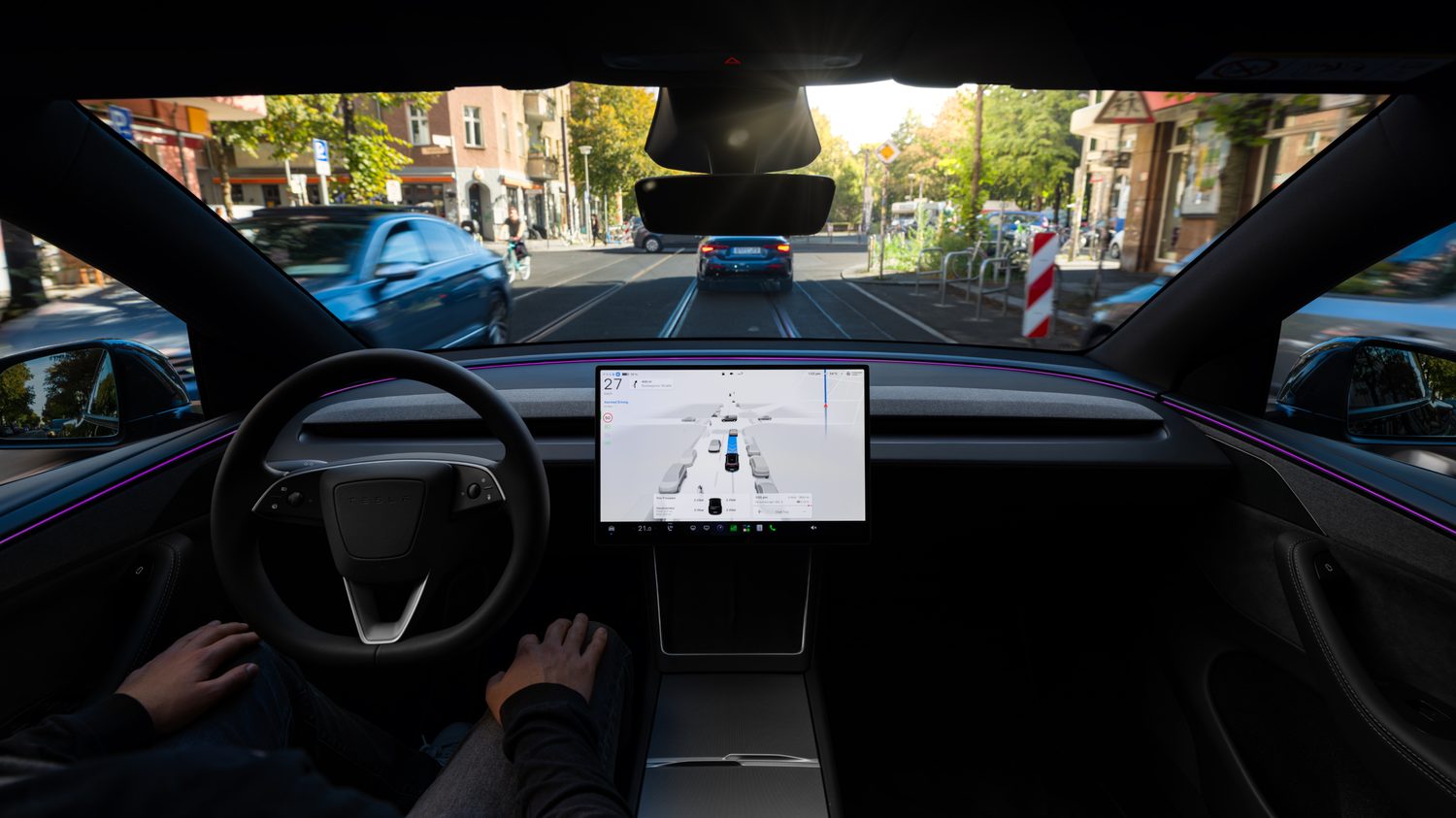
Tesla Assisted Driving (formerly FSD Supervised) is a SAE Level 2 system that can handle speed control, steering, lane changes, and complex intersections while the driver remains responsible. The Netherlands RDW issued the original provisional EU type approval. Latvia’s recognition of that approval brings the total to ten member states. Technical safeguards required by European regulators include reduced speed-overrun thresholds, automatic reset of manual speed offsets after each trip, and enhanced driver monitoring. These changes have been incorporated into the European software branch without compromising core neural-net performance.
Latest News & X Highlights
The official Robotaxi account captured the moment with characteristic flair:
Just hours earlier, Tesla Europe announced the Baltic breakthrough:
Community tracking accounts quickly noted that the ten approved EU countries now represent meaningful regulatory momentum, even if the population-weighted threshold for full EU-wide approval still requires additional major markets.
Real-world Applications & Implications
Houston’s expanded service area immediately increases addressable demand for airport transfers, medical-center trips, and suburban commuting. The presence of nearly 200 Cybercabs positions the city as a potential second public Cybercab market after Austin. In Europe, Latvia’s approval unlocks Assisted Driving for local Tesla owners and creates a regulatory precedent that neighboring markets are watching closely. Combined, these developments demonstrate Tesla’s dual-track strategy: rapid U.S. unsupervised scaling with Cybercab hardware while methodically securing supervised autonomy approvals across the European regulatory mosaic.
The economic implications are substantial. Every additional square mile of unsupervised operation multiplies fleet utilization and reduces per-mile cost. Every new European approval expands the software subscription revenue base and gathers diverse real-world data that further improves the global neural nets.
Final Verdict
October 26, 2026 will be remembered as a pivotal day in the robotaxi timeline. Houston’s bigger service area and Latvia’s regulatory green light together prove that Tesla’s vision-only, end-to-end autonomy stack is maturing at an accelerating pace. With Cybercab production ramping, driverless miles climbing past 3.65 million, and European approvals steadily accumulating, the path to true unsupervised robotaxi networks on both sides of the Atlantic is clearer than ever. The future of mobility is no longer a distant concept — it is already expanding, one geofence and one regulatory approval at a time. Buckle up: the next phase is going to be spectacular.