

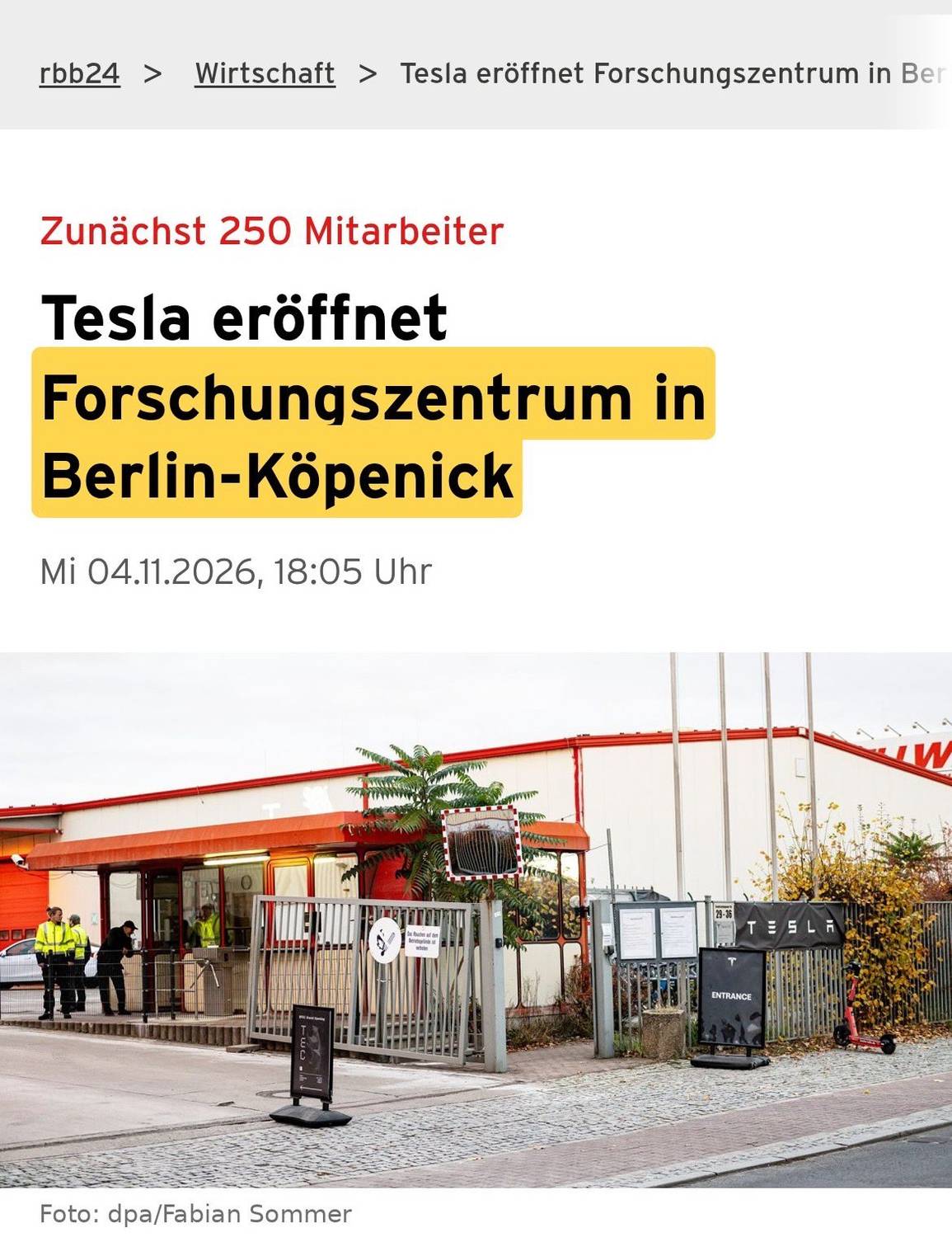
Tesla has just flipped the switch on a major European milestone. The brand-new Berlin Tesla Engineering Center in Köpenick is officially open, transforming what was once scattered development work into a single, high-velocity campus just 30 minutes from Giga Berlin. This is not another office building — it is Tesla’s third dedicated engineering hub after Fremont and Shanghai, designed from the ground up to compress the feedback loop between design, materials science, powertrain, vehicle engineering and validation. With an initial €100 million investment, more than 250 engineers and technicians already on site, and a clear path to 500 staff, the center signals Tesla’s deepening roots in Germany and its determination to accelerate the next generation of electric vehicles right here in Europe.
Key Features & Advantages
- ✅ Single campus consolidating four previous engineering sites into one high-efficiency location
- ✅ 30 specialized laboratories covering materials, powertrain, vehicle engineering, battery cells, safety testing and airbag validation
- ✅ Ultra-short feedback loop between development teams and the Giga Berlin production ramp
- ✅ Teams relocated from Tilburg (Netherlands) bringing proven expertise already applied to Model Y, Semi and Roadster
- ✅ Strategic 30-minute proximity to Giga Berlin for rapid prototype iteration and production support
- ✅ Scalable headcount: starting above 250 specialists with expansion to ~500 already in the permitting pipeline
- ✅ Third global engineering hub of its kind, matching the operational model proven in Fremont and Shanghai
Technical Specifications
- Official name: Berlin Tesla Engineering Center
- Location: Köpenick, Berlin — approximately 30 minutes from Giga Berlin (Grünheide)
- Investment: Around €100 million
- Initial workforce: Over 250 engineers and technicians
- Target workforce: Approximately 500 (expansion permit already applied for)
- Laboratory count: 30 dedicated labs
- Core lab focus areas: Materials science, powertrain systems, vehicle engineering & validation, battery cell development, safety testing including airbag systems
- Operational timeline: From permit to fully operational in under one year
- Global context: Third hub of this type after Fremont (USA) and Shanghai (China)
- Team origin: Significant transfer of specialists from Tesla’s Tilburg engineering operations in the Netherlands
- Prior contributions: Work already integrated into production Model Y, Tesla Semi and next-generation Roadster programs
In-Depth Technical Analysis
From Scattered Sites to Unified Campus
Until now, Tesla’s European engineering activities were spread across multiple locations. Bringing four engineering sites under one roof in Köpenick creates a single physical and organizational node where materials scientists, powertrain engineers, vehicle architects and validation specialists can iterate side-by-side. The stated goal is a dramatically shorter feedback loop between development and the production ramp at Giga Berlin — a capability that has proven decisive in both Fremont and Shanghai.
Laboratory Depth and Scope
The center houses 30 laboratories spanning the full vehicle development stack. Materials labs enable rapid characterization and qualification of new alloys, composites and battery materials. Powertrain labs support motor, inverter and drive-unit development. Vehicle engineering and validation spaces allow full-system integration and durability testing. Dedicated battery cell laboratories and safety facilities — including airbag and crash-related testing — close the loop on critical high-energy and occupant-protection systems. This breadth turns the campus into a true end-to-end development environment rather than a pure research outpost.
Speed of Execution
One of the most striking metrics is the timeline: from initial permit to operational status in under twelve months. In the European regulatory environment that pace is exceptional and demonstrates Tesla’s ability to move quickly once decisions are locked. The earlier public discussion of a more limited battery-safety laboratory with roughly 130 specialists has been superseded by a full engineering center that nearly doubles that headcount from day one and targets 500.
Talent Migration and Knowledge Transfer
A substantial portion of the initial team is relocating from Tesla’s existing engineering operations in Tilburg, Netherlands. These engineers already contributed to the current Model Y, the Semi program and the forthcoming Roadster. Their physical presence in Berlin ensures that hard-won know-how is transferred directly into the new German hub rather than remaining remote.
Latest News & X Highlights
Tesla Europe itself announced the opening with characteristic clarity, emphasizing the consolidation of four engineering sites onto one campus and the strategic value of the short feedback loop with Giga Berlin:
Detailed investment and staffing figures were rapidly confirmed by independent observers on the ground. One widely shared summary captured the scale of the commitment:
The posts highlight both the official narrative — speed, consolidation and proximity to production — and the concrete numbers that matter to engineers and investors alike: €100 million, 250+ specialists at launch, path to 500, and 30 laboratories covering the full development spectrum.
Real-world Applications & Implications
The Berlin Tesla Engineering Center is positioned to accelerate every major vehicle program that touches Europe. Closer collaboration with Giga Berlin should shorten the time from design freeze to production readiness for future Model Y variants, refreshed Model 3 derivatives, and the highly anticipated next-generation platforms. Battery cell and materials work conducted on site can feed directly into local cell production plans and pack design optimization. Safety and airbag laboratories enable region-specific validation without the lag of shipping prototypes across oceans.
For Tesla’s European supply chain the center acts as a magnet. Local suppliers gain a nearby engineering counterpart that can qualify materials and components faster. For talent, Berlin becomes a genuine alternative to the traditional automotive engineering centers in southern Germany, offering the unique combination of start-up pace and high-volume manufacturing reality.
Strategically, the move deepens Tesla’s industrial footprint in Germany beyond pure manufacturing. Grünheide builds the cars; Köpenick now develops them. That dual presence strengthens Tesla’s position in European policy discussions, energy and industrial strategy, and long-term investment planning.
Final Verdict
The Berlin Tesla Engineering Center is more than a new building — it is a statement of intent. In under a year Tesla has created a third global engineering hub that unites materials, powertrain, vehicle engineering and validation under one roof, staffed by hundreds of specialists and located a short drive from its most advanced European factory. The €100 million investment, the 30 laboratories, the rapid scaling path to 500 engineers and the explicit focus on shortening the development-to-ramp feedback loop all point to one outcome: faster, more ambitious electric vehicles designed and refined in Europe for the European market and beyond.
As the teams settle into Köpenick and the first prototypes begin cycling through the new labs, the real test begins. If the center delivers even a fraction of the velocity seen in Fremont and Shanghai, the next wave of Tesla products will carry a distinctly European engineering DNA — and the entire industry will feel the acceleration. The future of Tesla’s European engineering is no longer distributed. It is concentrated, energized, and open for business in Berlin.