

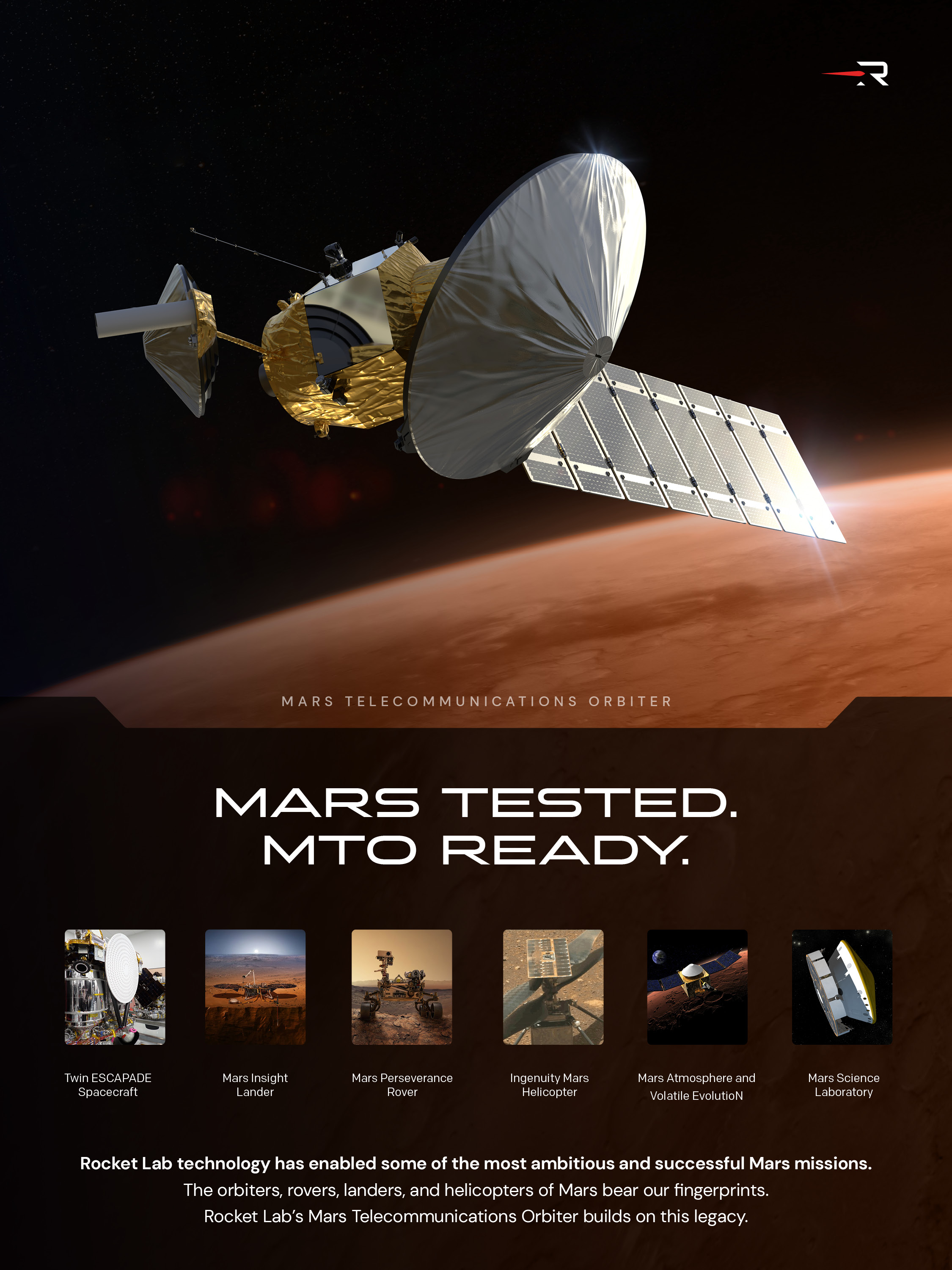
Rocket Lab has once again positioned itself at the forefront of deep-space innovation with its Mars Telecommunications Orbiter (MTO) concept. Announced through a series of compelling updates on X, the company emphasizes how robust communications infrastructure is the backbone of future Mars missions. This review dives deep into the technical merits of Rocket Lab’s MTO proposal, its alignment with NASA’s needs, and why it represents a critical step toward sustained human presence on the Red Planet.
With Mars exploration entering a new phase that includes robotic sample returns, crewed landings, and long-term habitats, reliable high-bandwidth data relay is no longer optional—it’s mission-critical. Rocket Lab’s MTO aims to solve the current bottlenecks in interplanetary communications, leveraging the company’s proven spacecraft platforms and deep-space heritage.
Why Mars Needs Better Telecommunications Infrastructure
Current Mars relay assets—including Mars Odyssey, the Mars Reconnaissance Orbiter (MRO), and MAVEN—are aging and operating well beyond their design lives. Data rates from the surface to Earth remain limited to just a few megabits per second during brief line-of-sight windows. One-way light-time delays of 4 to 24 minutes make real-time control impossible, forcing reliance on autonomous operations and opportunistic relay passes.
- Scientific instruments on rovers and landers generate terabytes of high-resolution data that often go untransmitted due to bandwidth constraints.
- Future human missions will require constant voice, video, telemetry, and science downlink support for crew safety and productivity.
- Autonomous systems, AI-driven science, and swarm robotics demand low-latency, high-throughput links between surface assets and orbit.
Rocket Lab’s MTO is designed as dedicated critical infrastructure to address these exact limitations, enabling a new scale of Mars exploration.
Rocket Lab’s MTO Technical Architecture and Capabilities
Built on Rocket Lab’s heritage spacecraft bus (the same platform proven on multiple deep-space missions), the MTO incorporates flight-proven hardware, radiation-hardened avionics, and advanced communications payloads. The orbiter will operate in a low-Mars orbit optimized for near-continuous relay coverage, supporting both X-band and Ka-band links with significantly higher data rates than existing assets.
- High-bandwidth relay: Expected to deliver multi-gigabit daily throughput to surface assets using modern optical and RF terminals.
- Autonomous operations: Onboard AI and machine-learning for dynamic scheduling of relay passes, fault detection, and data prioritization.
- Interplanetary networking: Laser communications terminals for direct Earth-Mars links at hundreds of Mbps, plus store-and-forward capabilities for surface swarms.
- Power and propulsion: High-efficiency solar arrays and electric propulsion for efficient orbit insertion and long-duration station-keeping.
- Mission lifetime: Designed for a minimum 5–10 year operational phase, with potential for extended service as part of a growing Mars telecommunications network.
Rocket Lab highlights “proven hardware, proven team, proven Mars experience” — a direct reference to their successful contributions to NASA’s CAPSTONE mission (lunar), ESCAPADE (Mars), and multiple commercial deep-space payloads. This heritage translates directly into lower risk and faster development for the MTO.
Rocket Lab’s Deep-Space Track Record: Why They’re MTO-Ready
Rocket Lab is not a newcomer to interplanetary missions. Their Photon spacecraft bus has already demonstrated precise trajectory control, radiation tolerance, and reliable communications in harsh space environments. The company’s vertical integration—from carbon-composite structures to reaction wheels, flight software, and solar arrays—provides end-to-end control that reduces schedule risk and cost.
- Successful Electron launches supporting NASA lunar and Mars precursor payloads.
- CAPSTONE: First spacecraft to operate in a near-rectilinear halo orbit around the Moon.
- ESCAPADE: Dual spacecraft mission to study Mars magnetosphere and solar wind interactions.
- Multiple commercial deep-space contracts demonstrating rapid iteration and high reliability.
Benefits for Science, Exploration, and Future Human Missions
The MTO is far more than a communications satellite—it’s the foundational layer for an entire Mars ecosystem. Higher data rates will accelerate discovery by allowing rovers to transmit full hyperspectral datasets, 3D terrain maps, and real-time instrument readings. For human exploration, it enables high-definition video streaming from the surface, continuous health monitoring, and seamless coordination between crews, habitats, and Earth-based mission control.
- Science return multiplier: 10–100× increase in daily data volume compared to current relays.
- Autonomy enablement: Onboard processing and relay reduce Earth dependency for time-critical decisions.
- Network scalability: Designed to integrate with future commercial and international orbiters, forming a true “Mars internet.”
- Cost efficiency: Leverages Rocket Lab’s low-cost, high-cadence production model to deliver capability faster and cheaper than traditional prime contractors.
By focusing on communications as the first infrastructure layer, Rocket Lab is applying the same philosophy that built the internet on Earth: build the network first, and everything else follows.
Strategic Implications for NASA and the Broader Mars Program
NASA’s Mars Architecture studies have repeatedly identified dedicated telecommunications orbiters as a high-priority gap. Rocket Lab’s MTO offers a commercially developed, rapidly deployable solution that aligns perfectly with the agency’s push toward public-private partnerships. With a targeted launch window supporting 2028–2030 arrival, the orbiter could be operational in time to support the Mars Sample Return campaign and early crewed mission precursors.
The technical maturity, combined with Rocket Lab’s aggressive timeline and cost structure, makes this proposal highly competitive. It also signals the maturation of New Space companies into providers of strategic national infrastructure for deep space.
Conclusion: A Critical Step Toward a Multi-Planetary Future
Rocket Lab’s Mars Telecommunications Orbiter is more than a spacecraft—it’s the digital nervous system that will connect humanity’s future on Mars. By delivering proven technology, innovative architecture, and unmatched production agility, Rocket Lab is ready to enable the science, exploration, and eventual settlement of the Red Planet. As the company states: “We’re Mars tested and MTO ready.” The next era of Mars discovery starts with communication, and Rocket Lab is poised to deliver it.
Watch the full announcements and technical overviews directly from Rocket Lab to see the vision in motion. The future of Mars exploration is brighter—and far more connected—thanks to this bold initiative.