

Tesla just dropped two major updates that push residential clean energy into a new era of intelligence and resilience. The latest Tesla Solar Panels now pack 18 independent power zones—three times more than conventional panels—delivering superior performance in the shade while the AI-powered Tesla Home system, included free with every Powerwall, automatically optimizes your entire home energy ecosystem. This in-depth technical review breaks down the specs, the real-world advantages, the engineering behind the cascading cell technology, the latest X highlights from Tesla Energy, and what these advances mean for homeowners ready to slash electricity bills and gain true energy independence.
Key Features & Advantages
- ✅ 18 independent power zones (3× conventional panels) dramatically reduce energy loss from partial shading
- ✅ 420 W rated power with 20.5% module efficiency for higher daily yield
- ✅ Cascading cell technology inherited from Tesla Solar Roof for superior shade tolerance
- ✅ Rail-less Tesla Panel Mount delivers up to 33% faster installation and 15% fewer roof penetrations
- ✅ All-black aesthetic with low-profile design that sits closer to the roof
- ✅ Tesla Home AI (powered by Opticaster) comes standard with every Powerwall—no extra hardware or subscription
- ✅ Real-time tracking of electricity rates, solar production, weather forecasts, and home loads
- ✅ Seamless integration across Solar Panels, Solar Roof, Powerwall, Wall Connector, and third-party devices
- ✅ 25-year product and performance warranty backed by Tesla
Technical Specifications
Here are the hard numbers that matter for system designers, installers, and performance-focused homeowners:
- Panel Power: 420 W (TSP-420) / 415 W (TSP-415 variant)
- Module Efficiency: 20.5% (420 W model)
- Power Zones: 18 independent zones via cascading cell architecture (3× typical residential panels)
- Dimensions: 71.1″ × 44.7″ × 1.57″ (1805 × 1135 × 40 mm) including frame
- Weight: 49 lbs (22.3 kg)
- Open-Circuit Voltage (Voc): ≈40.95 V
- Short-Circuit Current (Isc): ≈13.03 A
- Max System Voltage: 1000 V DC
- Operating Temperature: –40 °F to +185 °F (–40 °C to 85 °C)
- Warranty: 25-year product and performance
- Mounting: Rail-less groove-based Tesla Panel Mount—compatible with shingle, tile, metal, and flat roofs
- Installation Speed: Up to 33% faster than traditional rail-and-clamp systems
- Roof Penetrations: Up to 15% fewer while maintaining structural integrity
- Tesla Home: AI optimization engine (Opticaster) included with every Powerwall; no additional equipment required
- Compatibility: Native integration with Powerwall (all generations), Solar Roof, Wall Connector / Universal Wall Connector, and supported third-party devices via Tesla app
In-Depth Technical Analysis
Cascading Cell Technology & the 18-Power-Zone Advantage
Traditional residential solar panels typically divide cells into three series strings protected by bypass diodes. When even a small shadow—from a vent pipe, chimney, or tree branch—hits one cell, the entire string can drop out or force current through a diode, causing significant power loss. Tesla solved this by applying the same cascading cell technology proven on Solar Roof.
Laser-cut cells are arranged so that six parallel strings operate at lower current, creating 18 discrete power zones. When shade covers a portion of the panel, only the affected zone stops producing while the remaining 17 zones continue generating. Tesla’s own comparative testing showed meaningful gains:
- Under short-edge shading, conventional panels can lose ~50% of output; Tesla panels lose only ~33%
- In typical residential micro-shade scenarios, the architecture delivers a measured 22% higher AC energy yield per kilowatt installed versus conventional modules over multi-day full-sun periods
- No additional module-level power electronics (optimizers or microinverters) are required for shade mitigation—the intelligence is built into the cell layout itself
Rail-Less Mounting System
The new Tesla Panel Mount eliminates traditional rails and mid-clamps. The panel frame itself incorporates precision grooves that latch directly onto the mounts. This design reduces installation time by approximately one-third and cuts the number of roof penetrations by up to 15%, lowering both labor cost and long-term leak risk. The low-profile result sits closer to the roof surface, improving aesthetics and wind loading performance across shingle, tile, metal, and flat roof types.
Tesla Home: Opticaster AI Energy Management
Tesla Home is not an add-on—it ships with every Powerwall. At its core is Opticaster, Tesla’s proprietary AI optimization engine trained on over 100 million hours of real-world Powerwall operational data. The system continuously forecasts:
- Solar production based on weather and irradiance models
- Household load patterns that evolve with your usage
- Time-of-use electricity rates and demand charges
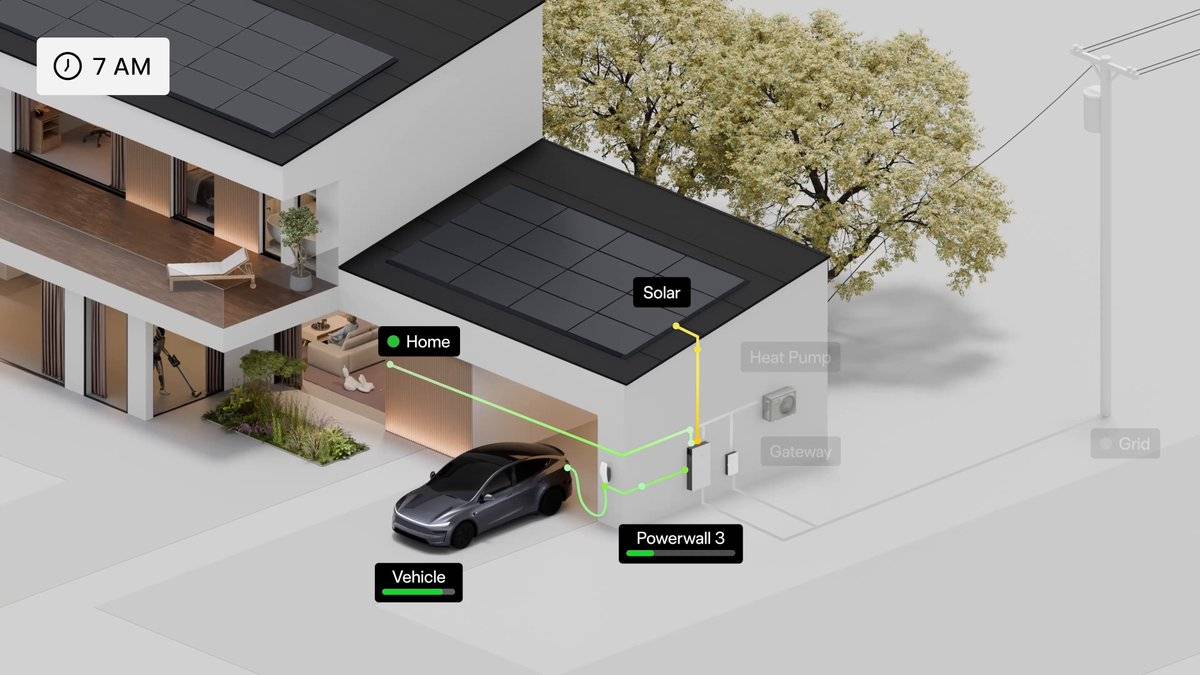
It then automatically decides when to charge the Powerwall, when to power the home from solar or storage, when to charge an EV via Wall Connector, and when to export or import from the grid. All of this is visible and controllable inside the Tesla app, with clear explanations of why the system is making each decision. The result is lower electricity bills without the homeowner needing to become an energy trader.
Latest News & X Highlights
Tesla Energy has been highlighting both products directly on X. Here’s the official word on the shade-performance leap:
And the seamless energy-management story that comes free with every Powerwall:
These posts underscore the dual focus: hardware that simply generates more usable energy under real-world roof conditions, and software that turns that energy—plus storage and EV charging—into an autonomous, bill-reducing system.
Real-world Applications & Implications
For homeowners with complex roofs, nearby trees, or multiple roof planes, the 18-zone architecture means more consistent production without the cost and complexity of optimizers on every panel. Installers benefit from dramatically faster rooftop time and fewer penetrations, improving both project economics and long-term reliability.
Tesla Home closes the loop. Once the solar array and Powerwall are installed, the AI continuously arbitrages time-of-use rates, prioritizes self-consumption, and coordinates EV charging so that solar energy powers both the home and the car. During grid outages the same ecosystem provides seamless backup, and with recent Powershare integrations the Cybertruck or compatible vehicles can further extend runtime.
Looking ahead, the combination positions Tesla’s residential energy platform for deeper virtual power plant participation, smarter demand-response programs, and tighter integration with future vehicle-to-home and vehicle-to-grid capabilities. The net effect is higher energy independence, lower lifetime cost of electricity, and a cleaner, more resilient home.
Final Verdict
Tesla’s new 420 W Solar Panels with 18 power zones and the AI-driven Tesla Home management system represent a genuine step-change in residential solar. The cascading cell design delivers measurable shade resilience that conventional three-zone panels simply cannot match, while the rail-less mount makes installation faster and cleaner. Pair that hardware with Opticaster AI that ships free with every Powerwall and you have a complete, self-optimizing energy ecosystem capable of lowering bills today and adapting to tomorrow’s rate structures and vehicle integrations.
For anyone evaluating a solar-plus-storage project in 2026 and beyond, this is the platform to watch—and very likely the one to install. The future of home energy is not just more watts on the roof; it is intelligent, shade-tolerant generation tightly coupled to predictive software that turns electrons into savings. Tesla just raised the bar again.