

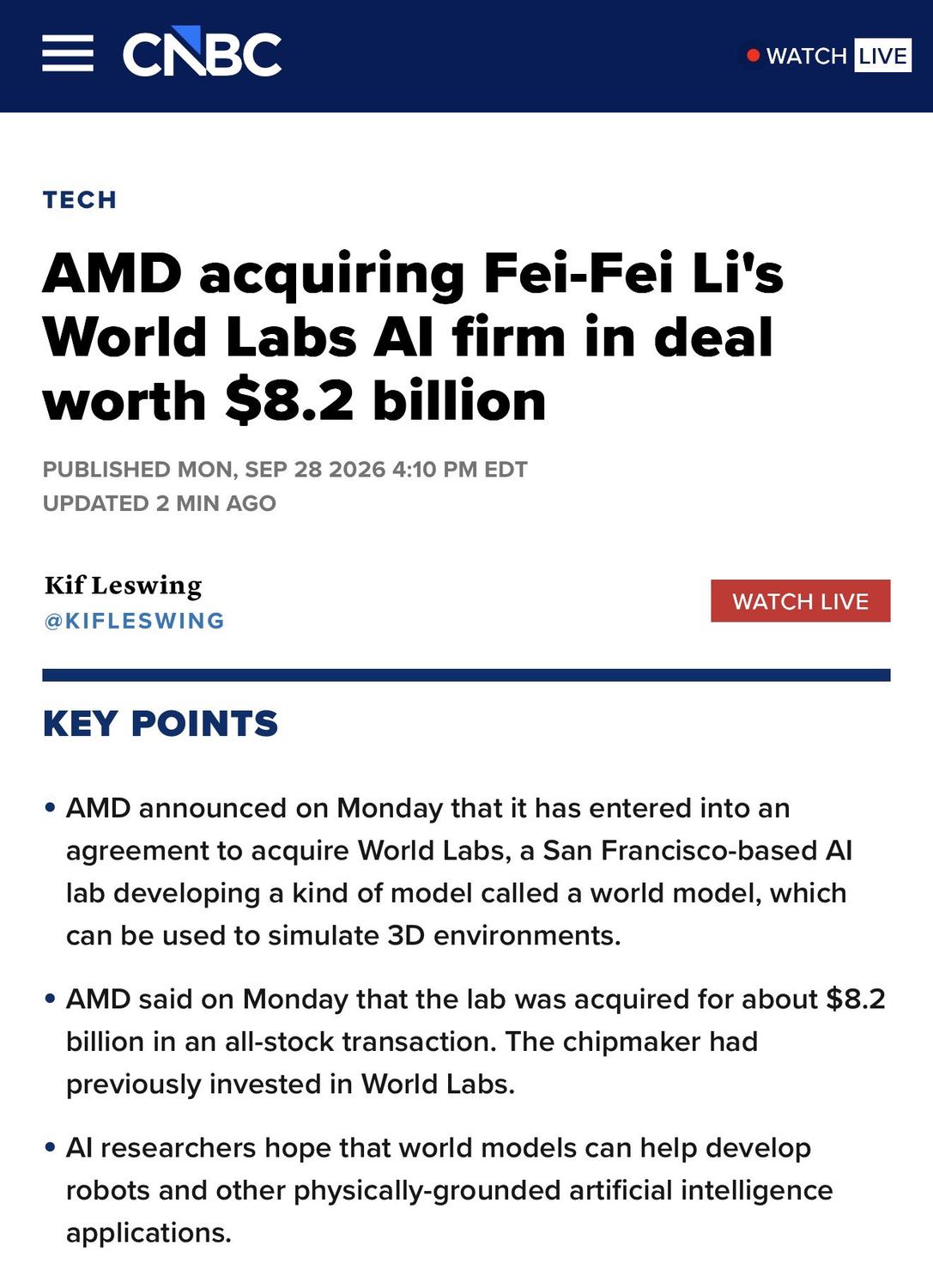
AMD just dropped one of the most strategically explosive moves in the AI semiconductor race. In an all-stock deal valued at approximately $8.2 billion, the company is acquiring World Labs — the spatial intelligence powerhouse founded by AI pioneer Dr. Fei-Fei Li. This isn’t just another talent grab. It’s a direct entry into the exploding world-model and physical AI market, giving AMD the Atlas foundation model, world-class research talent, and a clear path to co-design next-generation hardware with the exact workloads that will define the post-LLM era. In this deep technical review we break down the deal, the Atlas architecture, the hard numbers, the competitive implications against NVIDIA, and why this could reshape AI infrastructure for the decade ahead.
Key Features & Advantages
- ✅ Instant access to frontier spatial intelligence research and the Atlas omni world model
- ✅ Dr. Fei-Fei Li joins as Executive Vice President and Chief Scientist, reporting directly to CEO Dr. Lisa Su
- ✅ Co-founders Justin Johnson and Ben Mildenhall continue leading the research organization inside AMD
- ✅ End-to-end open AI ecosystem spanning hardware, software, platforms and widely accessible open models
- ✅ Massive acceleration of Real-to-Sim robotics, Gaussian splat generation, novel-view synthesis and physics-aware simulation
- ✅ Strategic leap into AI simulation markets previously dominated by NVIDIA’s NuRec, Cosmos, Isaac and Omniverse stack
- ✅ All-stock transaction preserves AMD cash for massive GPU capacity expansions while locking in critical IP and talent
Technical Specifications
- Deal Value: Approximately $8.2 billion all-stock transaction
- Expected Close: End of 2026 (subject to regulatory approvals)
- World Labs Founded: 2024 by Dr. Fei-Fei Li, Justin Johnson, Ben Mildenhall and Christoph Lassner
- Prior Valuation: ~$5 billion after $1 billion Series B (early 2026) that included both AMD and NVIDIA
- Team Size: Approximately 70 researchers and engineers joining AMD
- Flagship Model – Atlas: Multimodal autoregressive diffusion transformer pretrained from scratch on text, images, video, camera poses and 3D depth maps
- Video Generation: Up to 1 minute at 1440p with pixel-perfect camera path control
- Reconstruction: High-fidelity 3D scenes from as few as 2–3 images (up to 100+ images supported); outputs depth maps, point clouds and 3D Gaussian splats
- Spatial Context: Every image and depth map grounded at an explicit 3D camera pose
- Benchmark Edge: Atlas achieves average AbsRel error of 25.3 × 10⁻³ on sparse-view reconstruction — beating specialized open-source models (Pi3X 28.7, π³ 34.7, VGGT-Ω 36.4)
- Commercial Product: Marble – interactive persistent 3D world generator from text/image/video prompts (Gaussian splat + collision mesh output)
- Prior Partnership: Inference optimization and training collaboration already running on AMD GPUs
In-Depth Technical Analysis

The Strategic Context: Why World Models Matter Now
Language models predict the next token. World models predict the next state of physical reality. That distinction is the entire thesis behind World Labs. Dr. Fei-Fei Li has argued for years that true general intelligence requires grounding in physics, geometry and spatial relationships — capabilities that pure text or even 2D image models fundamentally lack. Synthetic data generated by accurate world models is rapidly becoming the missing fuel for general-purpose robotics, autonomous systems and advanced simulation. NVIDIA already recognized this with NuRec (neural reconstruction), Cosmos (world generation + physical reasoning) and the Isaac/Omniverse simulation layer. Until this acquisition, AMD was essentially a non-player in that entire stack. Now it owns one of the strongest pure-play spatial intelligence teams on the planet.
Atlas Architecture Deep Dive
Atlas is not a bolted-on 3D head sitting on a video or LLM backbone. It is an omni model designed from the ground up as a multimodal autoregressive diffusion transformer. Every input — text tokens, RGB frames, depth maps, camera poses — is projected into a shared spatial context. The model then generates the next element of the sequence autoregressively while using a rectified-flow diffusion process for continuous visual outputs. Because camera pose is a native first-class input rather than a text description, users can specify exact 6-DoF trajectories and receive geometrically consistent novel views. This solves the decades-old sparse-view novel-view synthesis problem with a single unified architecture.
- Native support for text, images, video (as image sequences), camera poses and depth maps
- Spatial context keeps generated views consistent even when the camera moves behind occluders or into previously unseen regions
- Explicit 3D outputs (point clouds + Gaussian splats) that drop directly into Unity, Unreal, Blender or robotics simulators
- Space-time simulation capability for VFX bullet-time effects and Real-to-Sim robot training
- Scaling behavior: performance continues to improve with additional training compute
Hardware Co-Design Opportunity
The real long-term prize for AMD is co-design. World models generate extremely different workload profiles from current LLM or diffusion training runs — massive 3D consistent memory access patterns, high-resolution multi-view rendering, continuous depth and splat generation, and long temporal sequences. By bringing the model researchers inside the same company that designs the Instinct GPUs and future AI accelerators, AMD can optimize silicon, software stacks and compilers years ahead of the market. Fei-Fei Li’s new role as Chief Scientist reporting directly to Lisa Su signals that this feedback loop will sit at the highest strategic level.

Latest News & X Highlights
The official announcements hit X on September 28, 2026 and the community reaction was immediate and intense.
World Labs itself framed the move clearly: accelerating spatial and physical intelligence requires scaling efforts, scaling reach, and getting closer to the hardware. Fei-Fei Li becomes EVP and Chief Scientist; Justin Johnson and Ben Mildenhall continue leading the research org inside AMD with a commitment to an open end-to-end AI ecosystem.
Analyst Daniel Romero of HyperTechInvest immediately zeroed in on the strategic implication: “$AMD enters the AI simulation market, challenging $NVDA dominance.” He detailed how Atlas reconstructs persistent 3D worlds from a few images, outputs depth maps, point clouds and Gaussian splats, and opens AMD to markets where it was previously a non-player. The $8.2B price tag looks expensive only until you consider a market that could reach hundreds of billions within a few years.
Crypto and AI commentator Ejaaz captured the broader sentiment: “holy crap: $0 to a $8,200,000,000 exit in 2 years… Fei-Fei Li is the godmother of AI… AMD can use their expertise to design and build next-gen AI chips that succeed the GPU… world labs now gets infinite compute to build the #1 world model.” The biggest bottleneck for any frontier lab has always been compute. World Labs just solved it at the source.
Real-world Applications & Implications
- Robotics & Embodied AI: Real-to-Sim pipelines that turn a few smartphone photos of a factory or warehouse into high-fidelity simulation environments for training general-purpose robots
- Autonomous Vehicles & Physical AI: Persistent 3D world models that improve perception, planning and synthetic data generation far beyond current camera/LiDAR approaches
- VFX, Gaming & Film: Minute-long 1440p camera-controlled sequences, bullet-time effects and fully explorable Gaussian-splat worlds generated from sparse reference images
- Architecture & Design: Instant conversion of concept sketches or site photos into navigable 3D environments with accurate geometry
- Scientific Simulation: Physics-aware digital twins for materials, biology and complex systems research
- Open Ecosystem Push: AMD’s stated commitment to open models and platforms could accelerate community adoption of spatial intelligence tooling outside the closed NVIDIA stack
The competitive implication is stark. NVIDIA has spent years building an integrated software moat around simulation. AMD has now purchased a world-class research engine and can begin co-designing silicon that is purpose-built for the exact memory, bandwidth and compute patterns these models demand. If Atlas and its successors become the reference world models for robotics and simulation, AMD Instinct accelerators gain a powerful new demand driver that is largely orthogonal to the current LLM training market.
Final Verdict
This is one of the cleanest strategic acquisitions in the AI semiconductor space in years. AMD paid a premium — roughly 64 % above the recent $5 billion valuation — but received the “godmother of AI,” a proven world-model architecture already beating specialized reconstruction baselines, and a direct line into the physical AI and simulation markets that many believe will dwarf today’s language-model workloads. The all-stock structure protects balance-sheet flexibility while the existing technical partnership means integration risk is unusually low.
Looking forward, the combination of Fei-Fei Li’s research vision with Lisa Su’s execution track record and AMD’s rapidly expanding GPU capacity creates a credible challenger to NVIDIA’s full-stack dominance in the next era of AI. Spatial intelligence is no longer a research curiosity — it is becoming infrastructure. And with Atlas now inside AMD, that infrastructure just gained a serious new architect. The next generation of AI chips will be shaped by the models that need them. AMD just bought the models.