

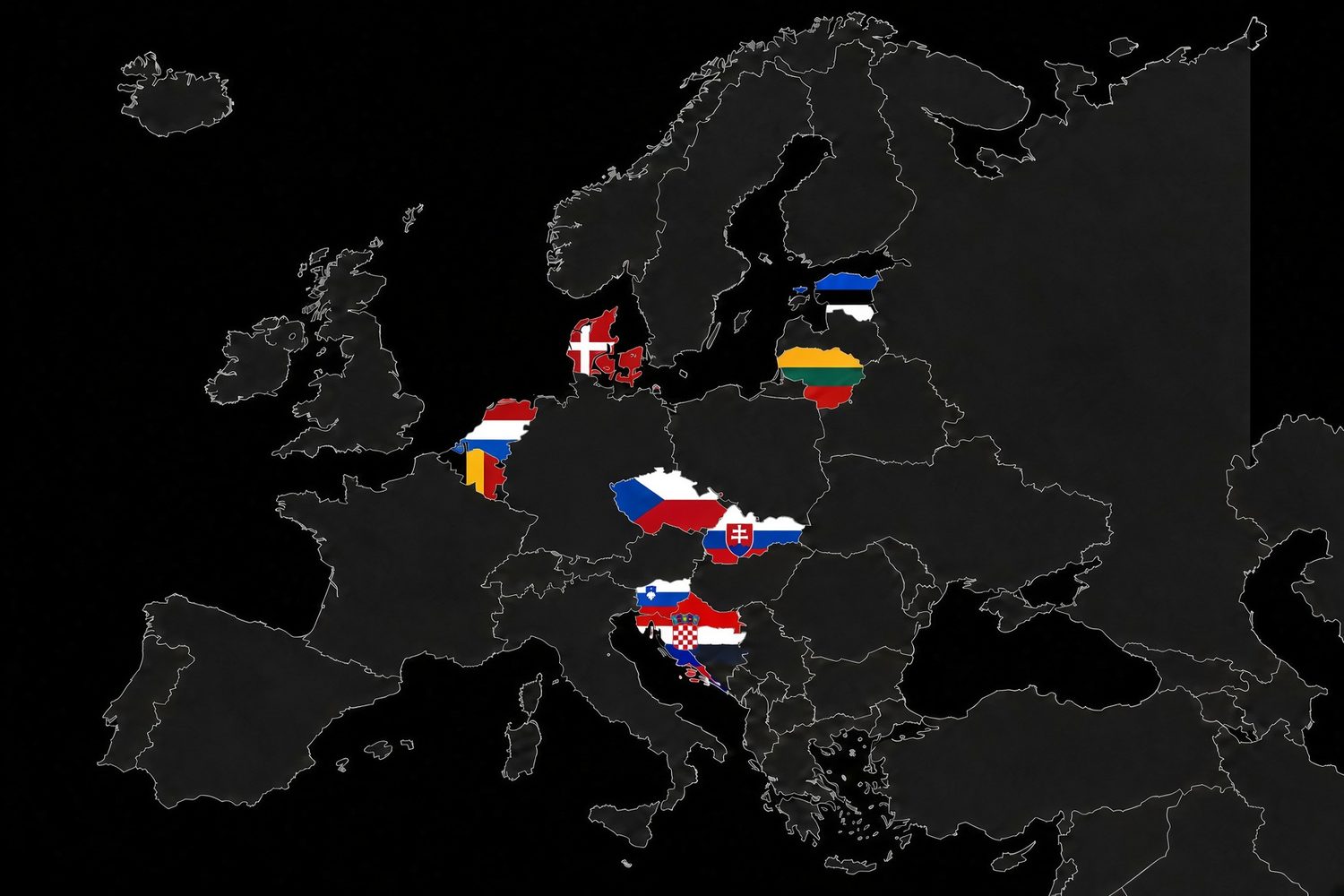
Huge news for European Tesla owners! Slovakia has officially green-lit Tesla’s Full Self-Driving (Supervised) system, becoming the ninth EU country to recognize the Dutch RDW provisional type approval. Rollout begins soon, unlocking advanced camera-based autonomy on Slovak roads and accelerating the path toward broader EU adoption. This in-depth technical review breaks down the key features, exact specifications, regulatory momentum, real-world implications, and what the latest X posts reveal about the rapidly expanding European FSD map.
Key Features & Advantages
- ✅ Vision-only neural network architecture enabling autonomous acceleration, braking, steering, lane changes, intersection handling, and traffic-light response under continuous driver supervision
- ✅ 360-degree camera coverage with up to 250 m forward range for superior situational awareness compared to traditional radar-centric systems
- ✅ Strict driver-monitoring camera that detects inattention and issues progressive alerts or disengagements
- ✅ Seamless recognition of the Dutch RDW Article 39 provisional approval, allowing rapid national rollout without full re-certification
- ✅ Proven safety multiplier: fleet data shows approximately 4.1× fewer collisions versus pure manual driving
- ✅ Hardware 4 (AI4) compatibility delivering multi-hundred TOPS of onboard compute for real-time end-to-end neural net inference
- ✅ Future-proof path toward EU-wide type approval once the 65 % population threshold is crossed
Technical Specifications
- Sensor Suite: 8 surround cameras (narrow forward 250 m, main forward 150 m, wide forward 60 m, side forward 80 m, rear 50 m, side rearward 100 m)
- Compute Platform: Hardware 4 / AI4 – dual or triple neural processing units delivering roughly 300–500 TOPS, 16 GB RAM, ARM Cortex-A78 cores
- Software Stack: End-to-end neural networks trained on billions of real-world miles; European-specific builds validated under UN R-171 and EU Regulation 2018/858 Article 39
- Operational Domain: Public roads in approved countries; handles urban intersections, multi-lane highways, roundabouts, and traffic signals while remaining SAE Level 2 (driver must remain attentive and ready to intervene)
- Driver Monitoring: Cabin-facing camera with continuous attention tracking; progressive warnings followed by system disengagement if needed
- Pricing Model (Europe): Subscription approximately €99 / month or one-time purchase options where available; free trial periods in some markets
- Compatibility: Vehicles equipped with Hardware 4 (generally 2023+ production); older HW3 vehicles remain limited to earlier Autopilot features
- Regulatory Status: Provisional type approval issued by Netherlands RDW (10 April 2026); national recognition via written notification under Article 39(5)
In-Depth Technical Analysis
Regulatory Pathway & European Momentum
The breakthrough rests on the Dutch RDW’s April 2026 provisional approval under Article 39 of Regulation (EU) 2018/858. Once a member state issues that provisional type approval, any other EU country may simply notify the RDW in writing that it recognizes the approval for its own territory. Slovakia completed exactly that step on 16 October 2026, joining the Netherlands, Lithuania, Estonia, Denmark, Belgium, Slovenia, Czech Republic and Croatia.
Collectively these nine countries represent 13.87 % of the EU population. Adding Germany’s strong political support pushes the figure to roughly 32 % of the 65 % population threshold required for qualified-majority EU-wide authorization. An EU Technical Committee vote is now expected no earlier than December 2026.
Vision-Only Architecture vs. Traditional Sensor Fusion
Tesla’s European FSD Supervised build is deliberately vision-only. Eight cameras feed a pure neural-network stack that performs perception, planning and control end-to-end. This contrasts with competitors that rely on heavy radar + LiDAR + HD-map fusion. The advantage is massive scale: every Tesla on the road continuously contributes training data, allowing rapid iteration of edge-case handling (complex roundabouts, unprotected left turns, European-style traffic-light sequencing).
- Real-time processing of multi-camera video streams at 36 fps
- Occupancy networks that predict 3-D space occupancy without explicit 3-D sensors
- Conservative European tuning that prioritizes restraint when confidence is low
- Continuous over-the-air validation against RDW-approved software versions
Safety Data & Driver Responsibility
Official statements emphasize that the system remains supervised. The driver is legally responsible at all times. Cabin camera monitoring is stricter than in many U.S. deployments, with faster escalation to disengagement. Fleet statistics cited by regulators show a 4.1× reduction in collision rates when FSD Supervised is engaged versus pure manual driving—powerful evidence that continues to sway national ministries.
Latest News & X Highlights
Tesla Europe itself announced the milestone with characteristic brevity:
Data specialist Roland Pircher provided the precise country-by-country timeline and population arithmetic that puts the approval in strategic context:
These posts capture the twin realities of the European FSD story: official confirmation that rollout begins soon, and the hard numbers showing how each national recognition moves the continent closer to critical mass.
Real-world Applications & Implications
For Slovak Tesla owners the immediate impact is clear: highway and urban supervised autonomy becomes legal as soon as Tesla enables the feature over-the-air. Cross-border travel among the nine approved nations will feel increasingly seamless. More broadly, every additional national recognition strengthens Tesla’s lobbying position for full EU type approval and demonstrates that camera-based systems can satisfy rigorous European safety and type-approval frameworks.
- Reduced driver fatigue on long motorway runs across Central Europe
- Lower insurance risk profiles as safety statistics accumulate
- Accelerated data collection from European road geometries, signage and driving cultures
- Competitive pressure on other OEMs to accelerate their own Level 2+ and Level 3 programs
- Political signal that smaller member states are willing to lead on innovation while larger markets deliberate
Final Verdict
Slovakia’s recognition of Tesla FSD Supervised is another decisive step in Europe’s quiet autonomy revolution. Nine countries, 13.87 % of the EU population, and a clear regulatory pathway already in place—momentum is building faster than many expected. With Hardware 4 compute, pure vision neural nets, and proven safety gains, Tesla continues to set the technical pace. As the December EU vote approaches and more nations join the list, the dream of continent-wide supervised autonomy is shifting from aspiration to engineering reality. The rollout begins soon—Europe’s roads are about to get a lot smarter.